The Custom FashionOS Platform Behind Fabletics' $1B+ Revenue — And Why Most Brands Can't Copy It
We mapped fabletics.com's entire technology infrastructure via DNS records, HTTP headers, and technology fingerprinting — revealing a proprietary platform, 120+ detected technologies, and a security posture with room to improve.
First: Why Should You Care About Another Brand's Tech Stack?
Hard data on what a $1B+ activewear brand actually builds vs. buys — and what it means for your stack
Because the build-vs-buy decision is the most expensive technology choice any ecommerce brand makes. We mapped Fabletics' entire technology infrastructure from public signals. Here's why their approach matters:
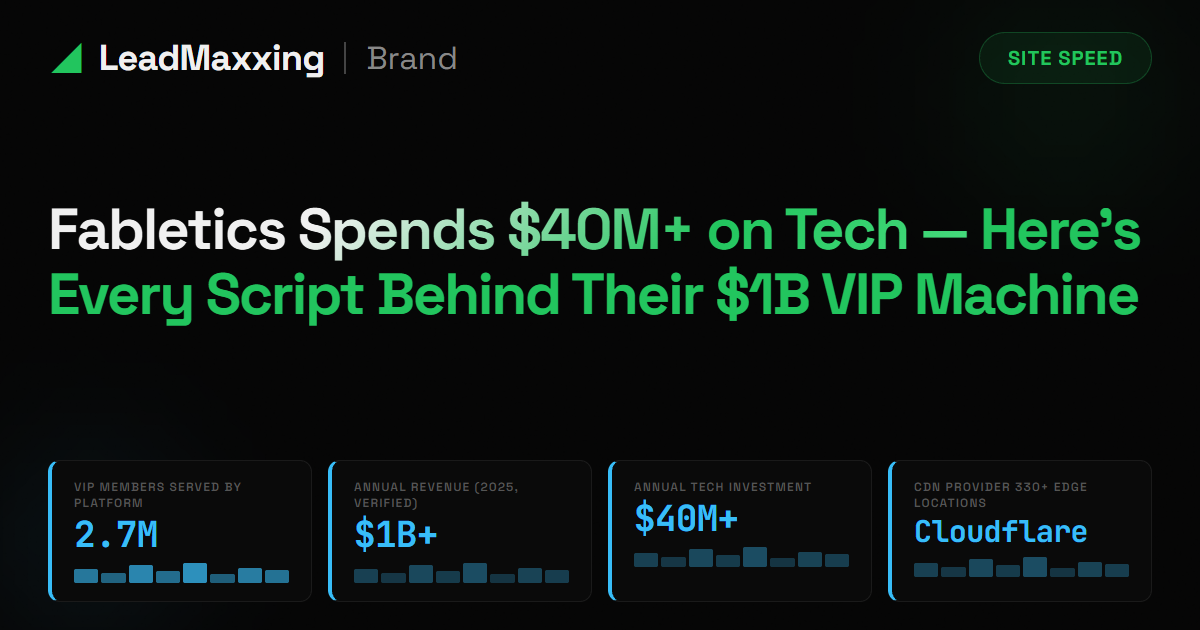
BuiltWith detects 120+ technologies on fabletics.com across 18 categories — but unlike most DTC brands, the majority of Fabletics' core technology is proprietary. Their parent company TechStyle Fashion Group built FashionOS, a complete e-commerce operating system with dedicated subsystems for membership, CRM, data, supply chain, and omnichannel retail. This build-over-buy approach is rare in DTC and reveals a fundamentally different growth philosophy.
Fabletics surpassed $1 billion in annual revenue in 2025 with 18% year-over-year growth — built on a proprietary technology platform rather than Shopify Plus or Magento. Their VIP membership model (2.7 million members accounting for ~95% of revenue) requires technology that off-the-shelf platforms simply don't provide, which is why TechStyle invested in a 120+ person engineering team instead of SaaS subscriptions.
Even billion-dollar brands have security gaps. Fabletics implements 4 of 6 critical security headers but is missing HSTS and CSP — two headers that most security-conscious brands prioritize. Their Permissions-Policy is impressively comprehensive (blocking 18 device APIs), but the absence of a Content-Security-Policy header means there's no browser-enforced whitelist controlling which third-party scripts can execute.
How We Got This Data
Technology fingerprints reveal everything.
Unlike brands with verbose CSP headers (which act as a public inventory of every tool they use), Fabletics doesn't send a Content-Security-Policy header. So we took a different approach: DNS records, HTTP response headers, and technology fingerprinting tools like BuiltWith and SecurityHeaders.com reveal the infrastructure underneath.
Their DNS A records point to Cloudflare IP addresses (104.18.42.9, 172.64.145.247), confirming Cloudflare as their CDN and security layer. Published case studies from Builder.io, Iterable, and Taggstar fill in the rest of the picture.
All data comes from publicly accessible HTTP response headers, DNS records, and technology detection tools. No private data, no account access, no proprietary code. Just reading what the server tells every browser on every page load.
This is exactly the kind of analysis LeadMaxxing runs automatically on any brand you point it at — tech detection, DNS recon, security audit, cost estimates — all in under 60 seconds.
Tool Breakdown by Category
11 key tools across four major categories.
The FashionOS Architecture
A proprietary operating system powering a $1B+ membership brand.
Fabletics doesn't run Shopify, Magento, or any off-the-shelf platform. Their parent company TechStyle Fashion Group built FashionOS — a vertically integrated e-commerce operating system with dedicated subsystems for every part of the business:
This fully proprietary architecture means Fabletics controls every layer — from DNS resolution through Cloudflare, to the React frontend managed via Builder.io, to the FashionOS backend handling membership billing, inventory, and fulfillment. The same platform also powers sister brands JustFab, ShoeDazzle, FabKids, and Savage X Fenty, giving TechStyle massive economies of scale across their portfolio. Their CTO Tim Collins has stated that workflows became “75% more efficient” after migrating the frontend to a React component architecture.
Building a proprietary platform is the highest-risk, highest-reward approach in ecommerce. It requires a 120+ person engineering team and years of investment, but gives Fabletics capabilities no SaaS platform provides — like tightly integrated membership billing, real-time RFID inventory across 114 stores, and AI-powered personal styling. Most brands under $100M in revenue should NOT attempt this.
Want This Analysis for Your Brand?
LeadMaxxing runs the same tech detection, DNS recon, and security audit automatically. Get your full report in 60 seconds when you create a free account.
Get Your Free Tech Stack Report → Free account — no credit card requiredThe Full Tech Stack
Every tool we identified, organized by category with pricing benchmarks.
Advertising Platforms (3 tools)
Fabletics runs paid ads primarily across Google and Meta, with AI-powered creative analytics layered on top:
Analytics & Personalization (3 tools)
Fabletics uses a lean external analytics stack because most personalization is handled internally by FashionOS subsystems:
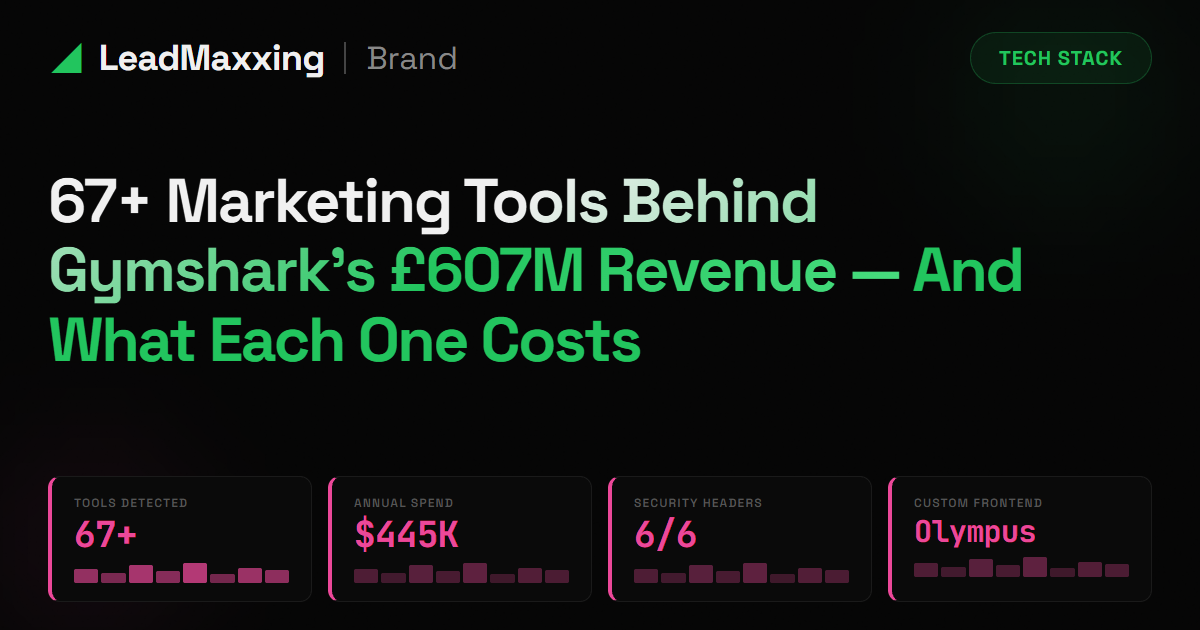
Because Fabletics built most of their analytics and personalization in-house, their third-party SaaS spend in this category is dramatically lower than competitors. Where Gymshark pays $150K-$250K/year for DynamicYield + mParticle, Fabletics' equivalent capability lives inside FashionOS — funded by engineering salaries instead of vendor contracts.
LeadMaxxing vs Fabletics' Personalization Stack
Fabletics invested millions in a proprietary personalization engine (Albert) backed by a 120+ person engineering team. LeadMaxxing's tracking script captures every visitor interaction — page views, scroll depth, form submissions, click IDs — building behavioral profiles automatically. Our AI reads this data to generate personalized landing pages and run A/B tests. Not FashionOS-grade, but 80% of the growth playbook for $29/month.
See how it works →Customer Engagement (2 tools)
Infrastructure & Operations (3 tools)
Security Headers: Grade C (4/6)
Strong in some areas, but two critical headers are missing.
Fabletics implements 4 of 6 standard security headers — including an impressively comprehensive Permissions-Policy. But the two missing headers are significant. Verify at securityheaders.com.
SAMEORIGIN — prevents clickjacking by blocking external iframe embedding.nosniff — prevents MIME-type confusion attacks.same-origin — only sends referrer data to same-origin requests, blocking referrer leakage to third parties.browsing-topics=() and interest-cohort=() — explicitly opting out of Google's tracking alternatives.Fabletics has a contradictory security posture: their Permissions-Policy is one of the most comprehensive we've seen (blocking 18 device APIs), yet they're missing the two most important headers (HSTS and CSP). This suggests strong awareness of privacy concerns (blocking Google's Topics API) but gaps in traditional web security hardening.
Curious how your own security headers stack up? LeadMaxxing's free report includes a full header audit with your score, missing headers, and fix-it instructions — no engineering background required.
The Cost Reality
What does a stack like this actually cost?
These are estimates based on publicly listed pricing tiers. Actual costs depend on contract terms, volume discounts, and custom enterprise agreements. Does not include proprietary FashionOS engineering costs.
This doesn't include significant ad spend across Google and Meta, the salaries of a 120+ person engineering team building FashionOS, or the cost of operating 114 physical retail locations with OmniSuite technology. Total technology investment: well into eight figures annually when engineering is included.
Automate the entire playbook with LeadMaxxing
LeadMaxxing scrapes competitor pages, generates landing pages from their styles, tracks every visitor interaction, runs autonomous A/B tests, and automates email campaigns from just $29. Or start with a free account today and get this analysis for your own brand as a free bonus.
Get Free Report + Account →How Fabletics Compares to Industry Benchmarks
Where they rank across key operational metrics.
Security: Mixed
4/6 security headers is above average for DTC brands, but missing HSTS and CSP prevents a top-tier grade. The Permissions-Policy is exceptionally thorough.
Platform: Exceptional
Fully proprietary e-commerce platform is extremely rare. Most DTC brands use Shopify Plus. Only Nike and a handful of others build at this level.
Membership Tech: Best-in-Class
2.7M VIP members generating ~95% of revenue. The membership billing infrastructure (Bento) is purpose-built and handles skip/charge/credit cycles that Shopify subscriptions cannot replicate.
Third-Party SaaS: Lean
Lower third-party SaaS spend than competitors because core capabilities are built in-house. Trade-off: higher engineering cost but more control and lower vendor lock-in risk.
Source: Compiled from BuiltWith, SGB Media, and SecurityHeaders.com data (2025-2026).
See how your brand compares
LeadMaxxing benchmarks your tech stack, security headers, and ad coverage against 100+ DTC brands automatically. Find out if you're top 3% or bottom 50% — and what to fix first.
Create a free account to benchmark your data →What Even Fabletics Could Improve
No brand is perfect. Here are the gaps.
Missing HSTS header
Without Strict-Transport-Security, browsers don't enforce HTTPS-only connections. Cloudflare can add this at the edge with a single toggle — a quick win for security posture.
No Content-Security-Policy
The absence of CSP means no browser-enforced whitelist for third-party scripts. Given Fabletics processes payments and stores membership data, a CSP header would significantly reduce XSS risk.
Platform vendor lock-in risk
While proprietary technology gives control, FashionOS creates internal lock-in. If TechStyle ever spins off a brand, migrating away from FashionOS would be a multi-year engineering project.
Engineering-heavy model
A 120+ person engineering team is expensive. At average tech salaries, that's $15-25M+ annually in engineering costs alone — a viable approach at $1B+ revenue, but unsustainable for brands under $100M.
The missing security headers are the easiest wins. Fabletics could go from a C to an A grade in under a day. The platform lock-in and engineering cost questions are strategic trade-offs, not mistakes. LeadMaxxing takes the opposite approach: one lightweight script that handles visitor ID, tracking, personalization, and email — no engineering team required.
Key Findings
- → Fabletics runs on FashionOS, a fully proprietary e-commerce platform built by parent company TechStyle Fashion Group's 120+ person engineering team — one of only a handful of DTC brands that don't use Shopify, Magento, or any off-the-shelf platform.
- → BuiltWith detects 120+ technologies across 18 categories on fabletics.com, but Fabletics' third-party SaaS spend is estimated at only $125K-$420K/year because core capabilities (personalization, data management, membership billing) are built in-house.
- → Fabletics scores a C grade (4/6) on security headers — implementing X-Frame-Options, X-Content-Type-Options, Referrer-Policy, and a comprehensive Permissions-Policy blocking 18 device APIs, but missing Strict-Transport-Security and Content-Security-Policy.
- → The brand surpassed $1 billion in annual revenue in 2025 with 18% year-over-year growth, powered by 2.7 million VIP members who generate approximately 95% of total revenue at $69.95/month (per SGB Media).
- → Fabletics consolidated its CRM stack into Iterable in 2023 for cross-channel messaging — finding that customers with 2+ marketing opt-ins are 2.5x more valuable, validating the multi-channel engagement approach (per BusinessWire).
What This Data Means for You
Turning Fabletics' tech stack into your competitive advantage
Fabletics proves that the build-vs-buy decision should be driven by your business model, not your ambition. Their membership model required capabilities that Shopify couldn't provide, so they built FashionOS. But most brands don't need a proprietary platform — you need the outcomes Fabletics gets (personalization, membership retention, cross-channel CRM) delivered through smarter tool selection and content strategy rather than a 120-person engineering team. Start with Fabletics' tool categories, not their architecture.
5 Things You Can Implement Today
Actionable lessons from Fabletics' tech stack playbook
Fix your security headers first
Fabletics scores a C — and so do most DTC brands. Add HSTS and CSP headers today. It takes 30 minutes and instantly improves your security grade. LeadMaxxing's free report includes a full header audit with your score and fix-it instructions.
Consolidate your CRM into one platform
Fabletics switched to Iterable and found that customers with 2+ opt-ins are 2.5x more valuable. If you're running separate email, SMS, and push tools, consolidating saves money and improves targeting. LeadMaxxing tracks every visitor touchpoint to help you build unified profiles.
Add social proof messaging to your product pages
Taggstar gave Fabletics a 3.19% conversion uplift with real-time social proof. Even simple “X people viewed this today” messaging moves the needle. LeadMaxxing's visitor tracking generates this data automatically from your traffic.
Use a headless CMS for content flexibility
Builder.io lets Fabletics' marketing team publish pages without engineering tickets. If your marketers wait days for developer time, a visual CMS pays for itself in velocity. LeadMaxxing generates landing pages automatically from competitor analysis — no CMS required.
Supercharge Your Leads with LeadMaxxing
Get a free LeadMaxxing account and start supercharging your leads. Start free →
Get This Analysis For Your Brand FREE
When You Create A Free LeadMaxxing Account
Create a free LeadMaxxing account and we'll generate a full competitive analysis for YOUR brand. The same intelligence you just read — comparison with competitors, actionable strategies, and AI-powered recommendations.
More Fabletics Intelligence
Tech Stack & Security for Similar Brands
Sources & References
builtwith.com
sgbonline.com
businesswire.com
developers.facebook.com
taggstar.com
builder.io
securityheaders.com
dig fabletics.com and curl -sI https://www.fabletics.com to verify.