30+ Marketing Tools Behind Alo Yoga's $400M+ Revenue — And What Each One Costs
We analyzed aloyoga.com's HTTP headers, DNS records, and technology fingerprints to map their entire marketing stack — an estimated $300K+/year across 30+ tools.
First: Why Should You Care About Another Brand's Tech Stack?
Hard data on what a $400M+ wellness brand actually spends on tools — and what it means for your stack
Because knowing what winning brands spend money on is the best market research you'll ever get. We mapped Alo Yoga's entire tool stack through technology fingerprinting and DNS analysis. Here's why the numbers matter:
Tech stack intelligence is the most underused competitive advantage in ecommerce. Every brand leaves technology fingerprints — JavaScript libraries, DNS records, cookie patterns, and embedded tags. Alo Yoga's stack reveals 30+ tools spanning advertising, analytics, CRM, and infrastructure. If you're not auditing competitor tech stacks, you're making tool decisions blind.
Understanding what winning brands actually spend on SaaS prevents the two most expensive mistakes: overspending on enterprise tools you don't need, or underspending on categories that drive real growth. Alo Yoga's estimated $300K+ annual stack shows exactly which tool categories matter at scale and which are table stakes.
Security header analysis reveals engineering maturity — not just security posture. Alo Yoga's 4/6 score means they've implemented the basics (HSTS, X-Frame-Options) but haven't locked down Referrer-Policy or Permissions-Policy. Monitoring competitor security headers over time shows you when they're tightening their infrastructure — a signal of operational maturity.
How We Got This Data
Technology fingerprints reveal everything — even without a verbose CSP.
Unlike brands with comprehensive CSP headers that list every allowed domain, Alo Yoga uses a minimal Content-Security-Policy: it blocks mixed content and frames but doesn't restrict which external scripts can load. This means the CSP doesn't serve as a tool inventory.
But every website still leaves technology fingerprints. We used BuiltWith, Wappalyzer, DNS analysis, and manual HTTP header inspection to map their complete stack. Combined with SecurityHeaders.com verification, this gives us a comprehensive view of their infrastructure.
All data comes from publicly accessible HTTP headers, DNS records, and technology detection tools. No private data, no account access, no proprietary code. Just reading what the server and its scripts tell every browser on every page load.
This is exactly the kind of analysis LeadMaxxing runs automatically on any brand you point it at — tech detection, DNS recon, security audit, cost estimates — all in under 60 seconds.
Tool Breakdown by Category
30 tools across four major categories.
The Shopify Plus + Cloudflare Architecture
Standard Shopify Plus with enterprise CDN and visual page building.
Alo Yoga runs a standard Shopify Plus store enhanced with Cloudflare's enterprise CDN and Builder.io for visual page creation:
Unlike brands that go fully headless, Alo Yoga uses Shopify Plus end-to-end — storefront, product pages, and checkout all run on Shopify's platform. They layer Builder.io on top for visual page building, giving marketing teams drag-and-drop control over landing pages without engineering bottlenecks.
Alo Yoga's architecture is pragmatic over custom. Instead of building a headless frontend (like Gymshark's "Olympus"), they maximize Shopify Plus's built-in capabilities and add best-in-class point solutions. Lower engineering overhead, faster time-to-market, but less control over page speed optimization and A/B testing.
Want This Analysis for Your Brand?
LeadMaxxing runs the same tech detection, DNS recon, and security audit automatically. Get your full report in 60 seconds when you create a free account.
Get Your Free Tech Stack Report → Free account — no credit card requiredThe Full Tech Stack
Every tool we identified, organized by category with pricing benchmarks.
Advertising Platforms (7 tools)
Alo Yoga runs paid ads across every major platform, with pixels and tags detected for all of these:
Analytics & Optimization (7 tools)
This is where Alo Yoga invests heavily. A multi-layered analytics stack for behavioral intelligence:
Heap + Optimizely alone likely cost Alo Yoga $50K-$150K per year. These analytics and testing tools are the backbone of data-driven product decisions at this scale. Google Analytics and GTM round out the stack as free essentials, while New Relic monitors application performance.
LeadMaxxing vs Alo Yoga's Analytics Stack
Alo Yoga pays $50K-$150K/year for Heap + Optimizely + Hotjar. LeadMaxxing's tracking script captures every visitor interaction — page views, scroll depth, form submissions, click IDs — building behavioral profiles automatically. Our AI reads this data to generate personalized landing pages and run A/B tests. Not enterprise-grade analytics, but 80% of the growth playbook for $29/month.
See how it works →Customer Engagement (7 tools)
Infrastructure & Operations (9 tools)
Additional infrastructure tools detected: Bugsnag (error monitoring), Loop Returns (returns/exchanges), Route (shipping protection), Back in Stock (restock alerts), Searchanise (search), and ThreatMetrix (device fingerprinting).
Security Headers: Grade C (4/6)
Four of six standard headers implemented — room for improvement on Referrer-Policy and Permissions-Policy.
Alo Yoga implements four of six standard security headers. The two missing headers — Referrer-Policy and Permissions-Policy — are common gaps for Shopify Plus stores. Verify at securityheaders.com.
max-age=7889238 — forces HTTPS for ~3 months. Lower than the recommended 1-year max-age, but functional.block-all-mixed-content; frame-ancestors 'none'; upgrade-insecure-requests — blocks mixed content and framing, but does not restrict external scripts. Minimal protection compared to comprehensive CSP policies.DENY — prevents clickjacking by blocking ALL iframe embedding, including same-origin.nosniff — prevents MIME-type confusion attacks.A 4/6 score is typical for Shopify Plus stores. Shopify controls most server-side headers, so adding Referrer-Policy and Permissions-Policy often requires Cloudflare Workers or custom proxy configuration. The minimal CSP is the bigger concern — it means any injected script can load from any domain, which could expose customer tracking data if the site is compromised.
Curious how your own security headers stack up? LeadMaxxing's free report includes a full header audit with your score, missing headers, and fix-it instructions — no engineering background required.
The Cost Reality
What does a stack like this actually cost?
These are estimates based on publicly listed pricing tiers. Actual costs depend on contract terms, volume discounts, and custom enterprise agreements.
This doesn't include significant ad spend across 7+ platforms, engineering salaries, or implementation costs. Total marketing technology investment: we estimate $200K-$400K annually based on published pricing tiers for each identified tool.
Automate the entire playbook with LeadMaxxing
LeadMaxxing scrapes competitor pages, generates landing pages from their styles, tracks every visitor interaction, runs autonomous A/B tests, and automates email campaigns from just $29. Or start with a free account today and get this analysis for your own brand as a free bonus.
Get Free Report + Account →How Alo Yoga Compares to Industry Benchmarks
Where they rank across key operational metrics.
Security: Average
4/6 security headers is typical for Shopify Plus brands. The minimal CSP leaves room for improvement compared to enterprise leaders scoring 6/6.
Stack Size: Above Average
30+ tools puts Alo Yoga well above typical DTC brands (15-20 tools) but below the most tool-heavy operators like Gymshark (60+).
Ad Platforms: Broad Coverage
7 advertising platforms (including programmatic via AdRoll and The Trade Desk) is comprehensive for a brand at this revenue level.
Analytics: Advanced
Running Heap + Optimizely + Hotjar simultaneously is above average for DTC. Most brands rely solely on Google Analytics — Alo Yoga adds behavioral depth.
Source: Compiled from BuiltWith, Wappalyzer, and Shopify ecosystem reports (2024-2026).
See how your brand compares
LeadMaxxing benchmarks your tech stack, security headers, and ad coverage against 100+ DTC brands automatically. Find out if you're top 3% or bottom 50% — and what to fix first.
Create a free account to benchmark your data →What Even Alo Yoga Could Improve
No brand is perfect. Here are the gaps.
Missing Referrer-Policy & Permissions-Policy
Two standard security headers are absent, leaking referrer data and allowing third-party scripts to access device APIs unchecked.
Minimal Content-Security-Policy
The CSP blocks mixed content but doesn't restrict script sources. Any injected script can load from any domain — a supply chain attack vector.
Short HSTS max-age
HSTS max-age of ~3 months (7,889,238 seconds) is below the recommended 1-year (31,536,000 seconds) and doesn't include preload.
Analytics tool overlap
Running Heap + Hotjar + GA + New Relic means significant overlap in behavioral tracking. Consolidating could reduce cost and script bloat without losing insight.
Most of these gaps — security headers, script overhead, overlapping analytics — stem from adding tools incrementally without auditing the full stack. LeadMaxxing takes the opposite approach: one lightweight script that handles visitor ID, tracking, personalization, and email — no CSP nightmare required.
Key Findings
- → Alo Yoga runs 30+ marketing tools detected via technology fingerprinting — spanning 7 ad platforms, 7 analytics tools, 7 engagement platforms, and 9 infrastructure services, with an estimated annual SaaS spend of $200K-$400K.
- → Alo Yoga scores 4 out of 6 on security headers (grade C), implementing HSTS, CSP, X-Frame-Options, and X-Content-Type-Options but missing Referrer-Policy and Permissions-Policy — typical for Shopify Plus stores.
- → Their Content-Security-Policy is minimal — blocking mixed content and frames but not restricting external script sources, meaning their tools are less exposed via CSP but also less protected against supply chain attacks.
- → Alo Yoga runs on Shopify Plus with Cloudflare CDN (confirmed by DNS A records 104.18.10.113/104.18.11.113), using Builder.io for visual page building rather than a custom headless frontend.
- → Heap Analytics + Optimizely alone cost an estimated $50K-$150K/year, representing the single largest line item in Alo Yoga's analytics budget — enterprise-tier behavioral tracking and experimentation few DTC brands under $100M invest in.
What This Data Means for You
Turning Alo Yoga's tech stack into your competitive advantage
Understanding exactly which tools a $400M+ wellness brand pays for — and what each one costs — lets you make smarter technology decisions. You can reverse-engineer the categories that matter (analytics, engagement, fraud prevention) without copying the enterprise price tags. Alo Yoga's approach is instructive: they use Shopify Plus as the backbone and layer best-in-class point solutions, keeping engineering overhead lower than brands that go fully custom. Pair this with their 7-platform ad strategy, Bluecore-powered email automation, and lifestyle-first social presence to see the full growth picture.
5 Things You Can Implement Today
Actionable lessons from Alo Yoga's tech stack playbook
Check your own security headers
Paste your domain into securityheaders.com. Most brands score D or F. Fixing it takes 30 minutes with Cloudflare Workers or your CDN's response header rules. LeadMaxxing's free report includes a full header audit with your score, missing headers, and fix-it instructions.
Audit your analytics stack for overlap
Alo Yoga runs Heap, Hotjar, GA, and New Relic — significant overlap. Before adding another analytics tool, check if your existing stack already captures the data you need. LeadMaxxing scans competitor tech stacks to show you exactly which tools they use so you can copy what works and skip redundancy.
Benchmark your tech stack against competitors
Alo Yoga runs 30+ tools but most brands under $50M need fewer than 15. LeadMaxxing's free report scans any competitor's technology fingerprint and tells you exactly which tools they use.
Replace 5 tools with one that handles tracking, personalization, and email
Alo Yoga pays $200K-$400K/year across 30+ tools. LeadMaxxing consolidates visitor identification, behavioral tracking, A/B testing, landing page generation, and email into a single $29/month platform.
Supercharge Your Leads with LeadMaxxing
Get a free LeadMaxxing account and start supercharging your leads. Start free →
Get This Analysis For Your Brand FREE
When You Create A Free LeadMaxxing Account
Create a free LeadMaxxing account and we'll generate a full competitive analysis for YOUR brand. The same intelligence you just read — comparison with competitors, actionable strategies, and AI-powered recommendations.
More Alo Yoga Intelligence
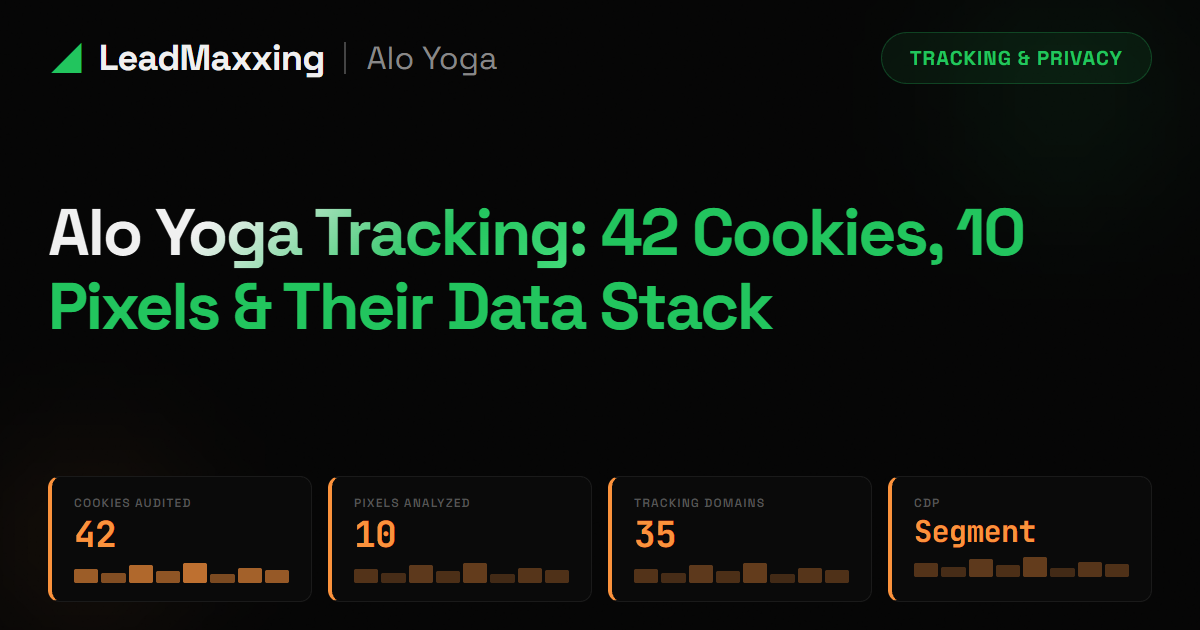
Tech Stack Audits for Similar Brands
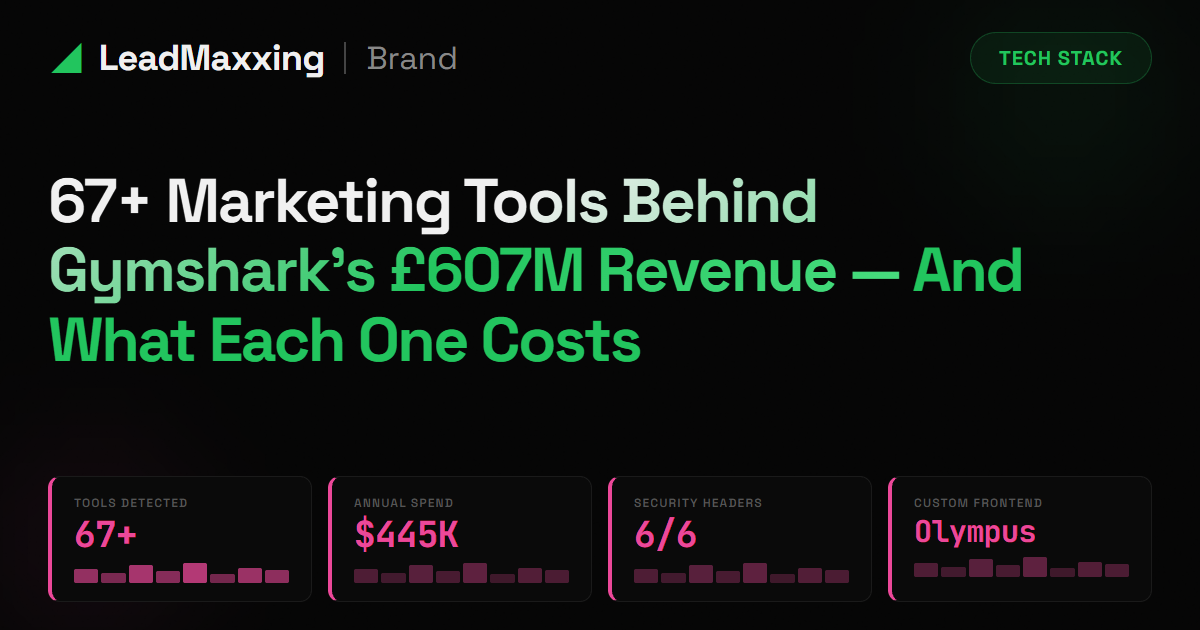
Sources & References
builtwith.com
wappalyzer.com
securityheaders.com
securitytrails.com
ecomm.design
curl -sI https://www.aloyoga.com to extract security headers and CSP policy. Cost estimates are based on publicly listed pricing tiers for each identified tool.