13 Years of Fabletics.com: From Celebrity Startup to $1B Membership Empire
We tracked every Wayback Machine snapshot of fabletics.com from 2013 to 2026 — 3,679 snapshots showing how Kate Hudson’s activewear brand evolved from a JustFab spin-off to a billion-dollar omnichannel empire.
The homepage is the highest-stakes page in ecommerce — and the one that changes most often. Fabletics has been archived 3,679 times since July 2013, averaging a new snapshot every 1.3 days. That’s a free, publicly available record of every strategic decision: when they added the membership gate, when they shifted from product grids to lifestyle imagery, and when the tech stack moved from a standard storefront to a custom headless architecture.
3,679
Fabletics has 3,679 archived snapshots in the Wayback Machine since 2013 — averaging one capture every 1.3 days. That frequency means we can track homepage changes at near-weekly resolution, from the original JustFab-style layout to the current headless React architecture.
In 2014, Fabletics' parent company paid a $1.8 million settlement in California over allegations that it did not clearly disclose that discounted products required a monthly membership charge. The homepage’s conversion flow — how prominently the membership terms were displayed — was central to the complaint.
Fabletics’ CTO reported that their Builder.io CMS migration made workflows 75% more efficient. Moving from a monolithic storefront to a headless React + Builder.io architecture let merchandising teams update the homepage without engineering tickets — the kind of speed advantage that separates testing cultures from static ones.
2013 — Launch year. Kate Hudson, Adam Goldenberg, and Don Ressler launch Fabletics under the JustFab umbrella. The homepage is a membership-gated quiz funnel — visitors pick a style profile before seeing any products.
How Fabletics evolved from a JustFab quiz funnel to a headless React architecture
Most DTC brands launch on Shopify and stay there. Fabletics took a different path — born inside TechStyle Fashion Group’s proprietary infrastructure, they inherited a membership-first platform from day one. Their tech stack has since evolved through three distinct eras, each unlocking the next revenue milestone.
JustFab Platform
$250M
2013–2017
StackJustFab/Custom
ChannelOnline only
StrategyQuiz funnel
Omnichannel Build
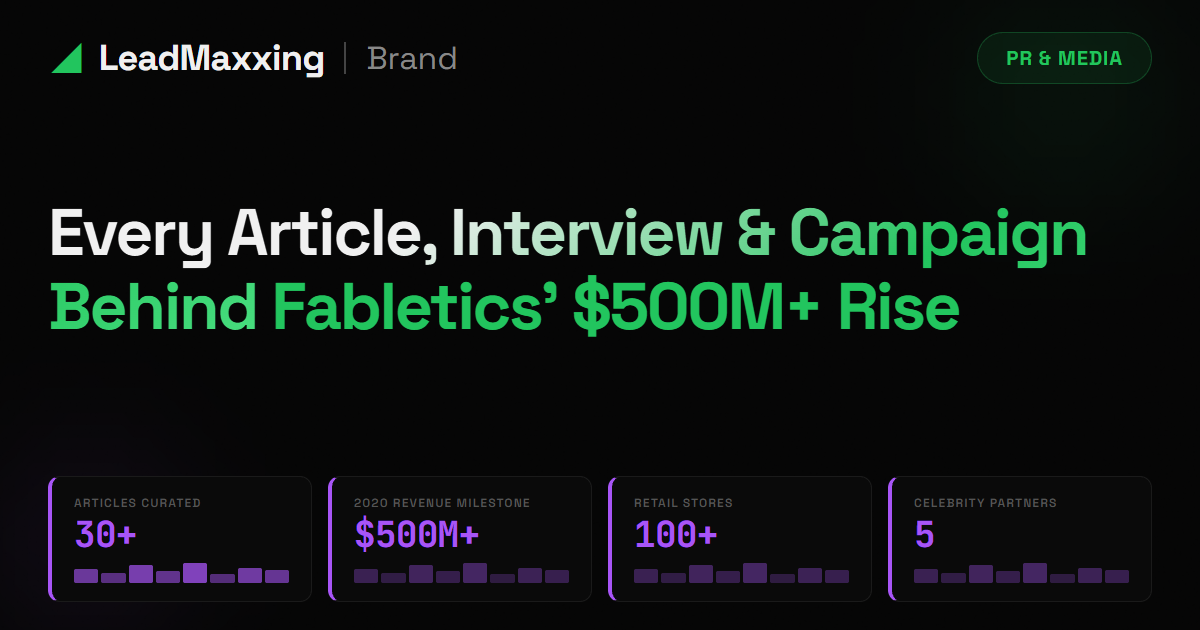
$500M+
2018–2022
StackOmniSuite
Stores75+
StrategyMembership hubs
Headless + Wholesale
$1B+
2023–2026
StackReact/Next.js
Stores100+
StrategyGlobal expansion
The Full Timeline
Every major homepage change from 2013 to 2026
2013
Launch. Kate Hudson, Adam Goldenberg, and Don Ressler launch Fabletics under TechStyle Fashion Group (formerly JustFab). The homepage is a membership quiz — visitors pick their workout style before seeing products. Online-only, built on JustFab’s proprietary platform. Founded
2014
Membership controversy. Parent company pays $1.8M California settlement over unclear membership disclosure. Homepage conversion flow becomes a legal and UX battleground — how prominently to display the $49.95/month VIP terms. $1.8M Settlement
2015
First physical stores. Fabletics opens its first retail locations, turning the homepage from the only storefront into one of many. The site begins promoting store locators alongside product drops. Pricing anchored at the VIP membership discount model.
2016-17
Rapid growth to $250M. Revenue hits a $250M run rate with 43% year-over-year growth in 2016 (per CNBC). Homepage shifts from quiz-first to product-first — lifestyle hero imagery replaces the enrollment funnel. Social media and influencer partnerships drive traffic. $250M run rate
2018
OmniSuite platform deployed. Fabletics launches its proprietary OmniSuite retail platform — a cloud-based system unifying e-commerce, POS, and order management across all channels. Stores become membership growth hubs with a 360-degree customer view.
2019
International push. Barcelona and London offices open. Homepage starts geo-targeting — UK visitors see localized pricing and collections. Ad strategy expands to support multi-market acquisition.
2020
Kevin Hart launches Fabletics Men. The homepage splits to serve two audiences: women’s activewear and men’s performance wear. Revenue crosses $500M with 2 million members. COVID gym closures accelerate email and digital engagement. $500M+ rev
2021
IPO exploration at $5B valuation. Fabletics hires Morgan Stanley, Goldman Sachs, Barclays, and Bank of America for a potential IPO. The IPO doesn’t materialize, but the preparation drives homepage polish — trust badges, press logos, and social proof get prominent placement. ~$5B valuation
2022-23
Headless CMS migration. Frontend moves to React.js with Builder.io as the headless CMS. Marketing teams gain visual editing without engineering tickets. Searchspring powers site search with a reported 102% revenue increase from search. The homepage becomes a living testing surface. React + Builder.io
2024
100+ stores, global expansion. Fabletics crosses 100 retail locations with 20% same-store sales growth. Stores open in Mexico (via Liverpool), Dubai, and Guatemala. The homepage promotes store locators and in-store exclusives alongside digital membership.
2025-26
$1B revenue, wholesale debut. Fabletics crosses $1 billion in annual revenue for the first time with 2.4 million US members. Wholesale launches via Nordstrom, Von Maur, and Zalando. Homepage now balances DTC membership, retail, and wholesale channels. SEO and content strategy scales to support 7+ international markets. $1B+ revenue
Key Findings
→ Fabletics has been archived 3,679 times by the Wayback Machine since July 2013, averaging one snapshot every 1.3 days — one of the most frequently captured DTC activewear sites.
→ The brand grew from zero to $1 billion in annual revenue by 2025, making it one of the fastest celebrity-founded DTC brands to reach that milestone (Glossy, 2024).
→ Fabletics’ migration to a headless React + Builder.io architecture made content workflows 75% more efficient, according to their CTO (Whitespectre case study).
→ The Kevin Hart menswear partnership, launched in 2020, grew Fabletics Men into a $300 million business line within five years (WWD, 2025).
→ Every major revenue milestone ($250M → $500M → $1B) was preceded by a platform or channel expansion — from online-only to 100+ retail stores to wholesale via Nordstrom.
What This Data Means for You
Turning Fabletics' evolution into your competitive advantage
Fabletics’ homepage evolution tells a story most DTC brands will recognize: the transition from acquisition funnel to omnichannel hub. Their early quiz-gated homepage was a conversion machine — but it couldn’t serve in-store customers, wholesale partners, or international markets. The React + Builder.io migration solved that by decoupling content from commerce. You can see the same pattern in their tracking and privacy infrastructure, their site speed optimization, and their multi-platform ad strategy. The playbook is clear: invest in platform flexibility before you need it.
◢
LeadMaxxing Automates This Entire Playbook
Fabletics spent years building OmniSuite and migrating to headless React to let marketing teams move fast. LeadMaxxing gives you that same speed from day one: our AI scrapes competitor homepages, extracts layout patterns and CTAs, generates landing page variants, and runs autonomous A/B tests. Winners auto-apply at 95% statistical significance. What took Fabletics an engineering team and a $5B valuation target, LeadMaxxing does for $29/month.
Actionable lessons from Fabletics' homepage playbook
Gate less, personalize more
Fabletics' early quiz funnel converted well but limited discovery. They eventually moved to open product browsing with personalized recommendations. LeadMaxxing tracks visitor behavior and auto-generates personalized landing pages — the same effect without a gate.
Split your homepage for multiple audiences
When Fabletics added menswear in 2020, the homepage had to serve two audiences. Segment your homepage by visitor intent. LeadMaxxing creates audience-specific variants and tests them automatically — no engineering ticket required.
Adopt a headless CMS before you hit the content bottleneck
Fabletics' Builder.io migration made workflows 75% more efficient. If your marketing team waits on developers for every homepage change, you're losing testing velocity. LeadMaxxing's visual editor gives you that same independence.
Use stores to reinforce digital membership
Fabletics turned retail into membership growth hubs with a 360-degree customer view. Track which channels drive the highest LTV. LeadMaxxing monitors visitor journeys across pages, attributing conversions to the touchpoints that matter.
Supercharge Your Leads with LeadMaxxing
Get a free LeadMaxxing account and start supercharging your leads. Start free →
Free — No credit card required
Get This Analysis For Your Brand FREE When You Create A Free LeadMaxxing Account
Create a free LeadMaxxing account and we'll generate a full competitive analysis for YOUR brand. The same intelligence you just read — comparison with competitors, actionable strategies, and AI-powered recommendations.
✓ Auto-generated brand report✓ Competitor comparison✓ Strategy recommendations✓ AI-powered insights✓ Free LeadMaxxing account to supercharge your leads
Get Free Report + Account →Free plan includes visitor tracking, lead scoring, and AI chat. Paid plan $29/month for full access.
What ecommerce platform does Fabletics use in 2026?
As of 2026, Fabletics runs a custom headless architecture built on React and Next.js with Builder.io as their CMS. Their proprietary OmniSuite platform handles POS, order management, and back-office systems across 100+ retail locations. The frontend is component-driven, with Searchspring powering site search and Builder.io enabling visual content editing for marketing teams.
When was Fabletics founded and by whom?
Fabletics was co-founded in July 2013 by Adam Goldenberg, Don Ressler, and Kate Hudson under the TechStyle Fashion Group (formerly JustFab Inc.) umbrella. Goldenberg and Ressler were co-CEOs of JustFab, while Hudson served as co-founder and the public face of the brand. Hudson transitioned to an advisory role in 2021.
How does the Fabletics VIP membership model work?
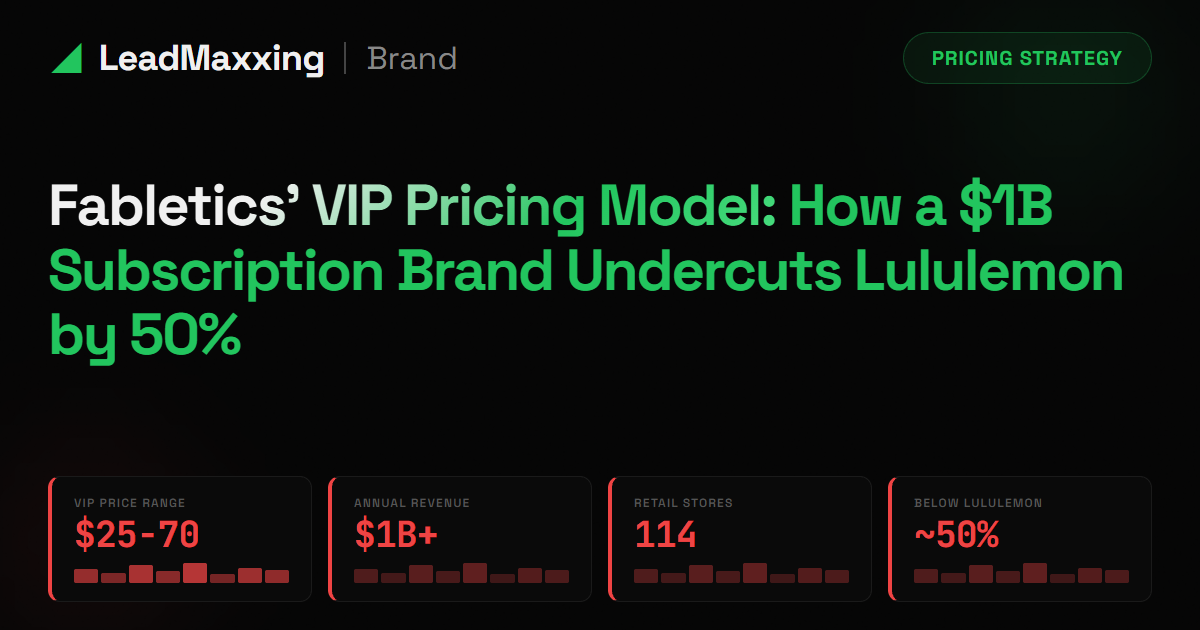
Fabletics charges VIP members $59.95 per month, which converts into a store credit worth $100+ in product. Members must actively “skip the month” between the 1st and 5th to avoid being charged. This membership-first model has driven recurring revenue but also generated significant consumer complaints, including over 1,100 BBB complaints in a three-year period and a $1.8 million settlement in California in 2014.
How many retail stores does Fabletics have?
As of early 2026, Fabletics operates over 100 retail locations across the US, Canada, the UK, and Europe, with recent openings in Mexico, Dubai, and Guatemala. The company averages roughly 20 new store openings per year and has plans to open approximately 40 more stores in 2026, split between domestic and international markets. Their long-term target is 250 stores.
What happened to the Fabletics IPO?
In 2021, Fabletics retained Morgan Stanley, Goldman Sachs, Barclays, and Bank of America to prepare for an IPO targeting a $5 billion valuation and aiming to raise nearly $500 million. However, the IPO did not materialize, and Fabletics remains a private company under TechStyle Fashion Group as of 2026.
How did Fabletics grow from zero to $1 billion in revenue?
Fabletics grew through distinct phases: online-only membership launch (2013–2015), physical retail expansion starting in 2015, the Kevin Hart menswear partnership in 2020, international expansion to 7+ countries, and wholesale entry via Nordstrom in 2025. The brand surpassed $500 million in annual revenue by 2020 with 2 million members, and crossed $1 billion in revenue in 2025 with 2.4 million US members.
How does Fabletics compare to Lululemon and other activewear brands?
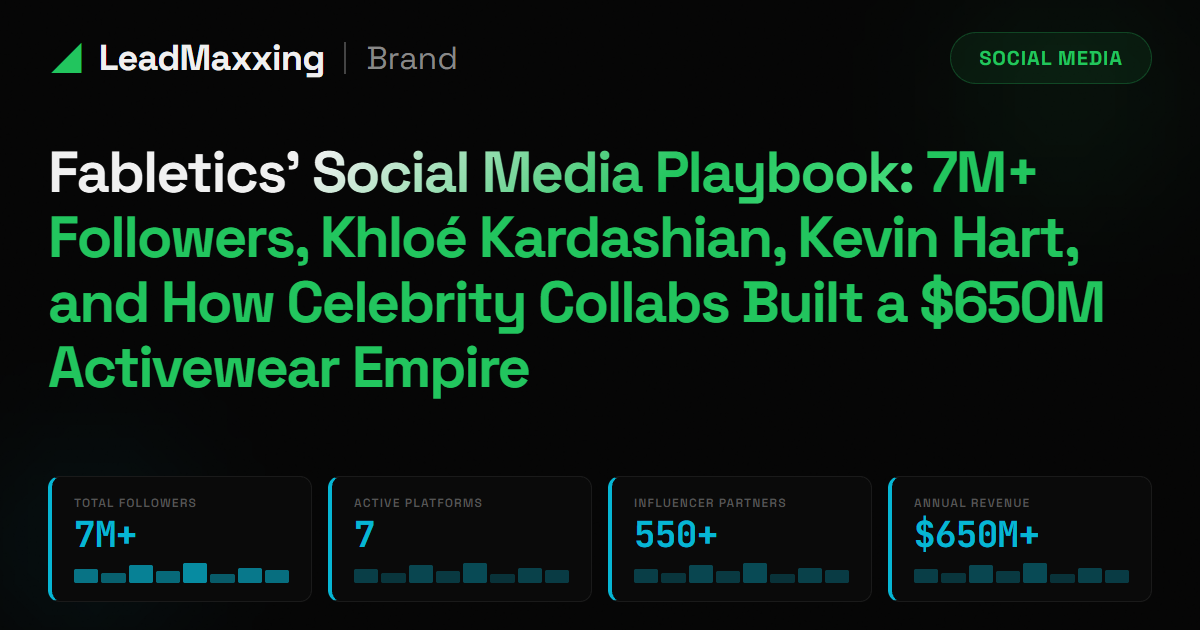
Fabletics positions itself as accessible premium activewear, with leggings maxing out at $110 versus Lululemon at $148. While Lululemon operates 700+ stores with $9B+ revenue, Fabletics differentiates through its membership model, celebrity partnerships (Kate Hudson, Kevin Hart, Khloé Kardashian), and aggressive international expansion. Fabletics menswear, launched in 2020, has grown to a $300 million business line.
What technology powers the Fabletics website?
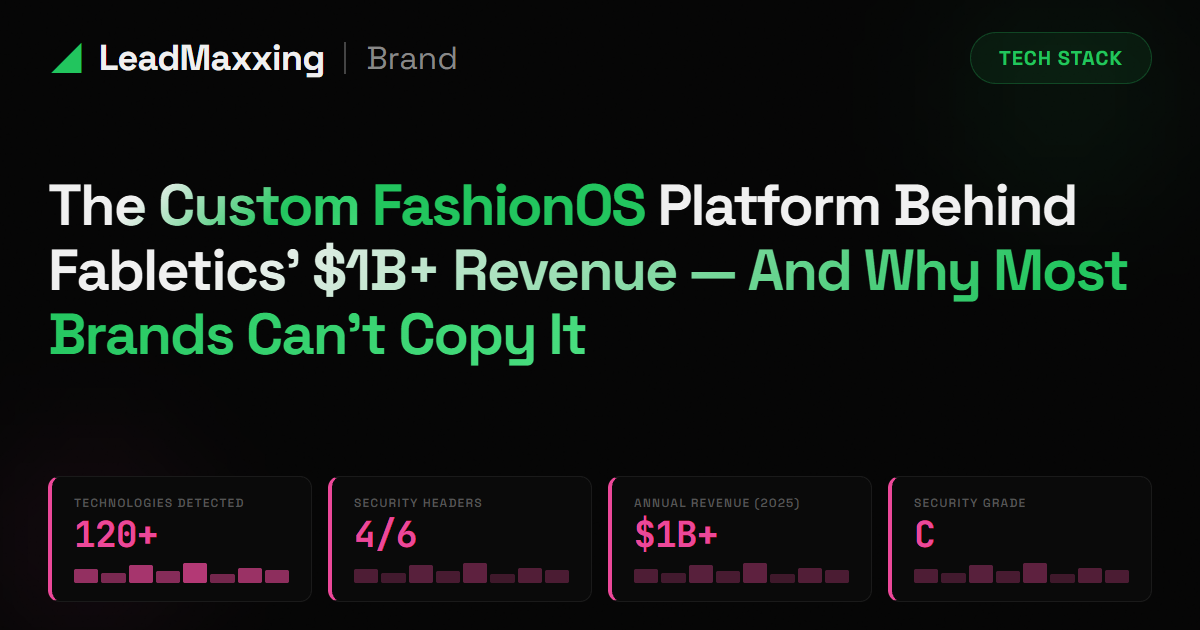
Fabletics uses a modern headless commerce architecture: React.js and Next.js frontend, Builder.io as their headless CMS, a custom commerce backend with products microservice, and Searchspring for site search. Their proprietary OmniSuite platform connects e-commerce, POS, and order management across all channels. The Builder.io migration made workflows 75% more efficient according to their CTO.
Sources & References
Wayback Machine / Internet Archive — 3,679 archived snapshots of fabletics.com from 2013 to 2026, used to reconstruct the full homepage evolution timeline.
web.archive.org
Glossy / Modern Retail — Inside Fabletics’ plan to become a $1 billion brand: revenue figures, store count, membership data, and international expansion plans.
glossy.co
Whitespectre × Fabletics Case Study — Technical details of the Builder.io headless CMS migration, React component architecture, and the 75% workflow efficiency improvement.
whitespectre.com
WWD (Women’s Wear Daily) — Fabletics Men’s $300 million business line growth under the Kevin Hart partnership since 2020.
wwd.com
CNBC — Kate Hudson’s Fabletics revenue milestones and business model evolution from 2013 to 2017.
cnbc.com
BuzzFeed News — Investigation into Fabletics’ membership billing practices, $1.8M settlement, and consumer complaint patterns.
buzzfeednews.com
Digital Commerce 360 — Fabletics’ Blue Yonder supply chain tools and 2025 expansion plans including wholesale and international growth.
digitalcommerce360.com
Compiled by LeadMaxxing using Wayback Machine data. We track how brands build, test, and optimize their marketing.