Lululemon Runs 50+ Third-Party Scripts — Here's What $11.1 Billion in Revenue Rides On
Every script, CDN, and infrastructure decision behind lululemon.com — and what ~520KB of third-party JS is actually costing them in PageSpeed.
FY2025 (verified)
global edge network
loaded per page
in CSP header
First: Why Should You Care About Site Speed?
Hard revenue data from Google, Portent, and Deloitte that proves speed is money
Because every second costs you real money. This isn't a vanity metric. Google, Deloitte, and Akamai have all studied this, and the numbers are brutal:
Sites loading in 1 second have 5x higher conversion rates than sites loading in 10 seconds. Not 5% more. Five times more.
Bounce rate increases 90% when load time goes from 1 second to 5 seconds. Nine out of ten people who would've stayed on your site just... leave.
A 0.1-second improvement in mobile speed = 8.4% more conversions in ecommerce. That's not a typo. One tenth of a second. Google measured this across real retail sites.
Lululemon gets this. With $11.1 billion in annual revenue (FY2025, verified fact) and roughly 40% of sales flowing through digital channels, every millisecond of load time translates to real dollars. That's why they run on Akamai — one of the world's largest CDN providers — and invest in enterprise-grade infrastructure that can handle traffic surges from 811 stores and seasonal spikes without blinking.
Speed gets visitors to the page. But do you know who they are? LeadMaxxing identifies your anonymous visitors and scores them so you know which ones are worth chasing.
Core Web Vitals: The 3 Numbers Google Actually Uses to Rank You
LCP, INP, and CLS explained with Lululemon's real field data
Google doesn't care about your Lighthouse score. Seriously. Lighthouse is a lab test — it's a simulation. What Google actually uses for rankings are Core Web Vitals: real data from real Chrome users visiting your real site over the last 28 days. Three numbers:
| Metric | Plain English | Good | Bad | Why It Matters |
|---|---|---|---|---|
| LCP | How fast the main content appears | < 2.5s | > 4.0s | Users see a blank screen until LCP fires. Slow LCP = they leave before seeing your product. |
| INP | How fast buttons & clicks respond | < 200ms | > 500ms | 43% of sites fail this in 2026. When "Add to Cart" feels laggy, people don't add to cart. |
| CLS | How much the page jumps around | < 0.1 | > 0.25 | Ever try to tap a button and the page shifts so you hit the wrong thing? That's CLS. Users hate it. |
Lululemon faces a unique challenge here. With 50+ third-party services detected in their Content-Security-Policy header — from analytics platforms to payment providers to personalization engines — every one of those scripts adds JavaScript that competes for the browser's main thread. The more scripts, the harder it is to hit INP targets. Users are 24% less likely to abandon a page when it passes all three Core Web Vitals. That's the difference between a site that converts at scale and one that leaks money. Core Web Vitals are also a confirmed SEO ranking signal, which means slow sites lose twice: visitors leave AND Google ranks you lower.
Run a live PageSpeed test on lululemon.com right now → — you'll see their real CrUX field data.
Think of it like a restaurant. LCP is how fast the food arrives. INP is how quickly the waiter responds when you flag them down. CLS is whether your plate slides off the table while you're eating. Google measures all three for every visitor, and if your site fails, it ranks lower. Period.
The Enterprise Stack Behind $11B in Revenue
How Lululemon built a Salesforce Commerce Cloud + Akamai architecture for global scale
Lululemon doesn't run Shopify. While most DTC athleisure brands build on Shopify Plus, Lululemon runs Salesforce Commerce Cloud (SFCC, formerly Demandware) — an enterprise commerce platform designed for global, multi-region, multi-currency operations. This is confirmed by active job postings on their careers page seeking "Senior SFCC Software Engineers" and by BuiltWith technology detection.
Their CDN is Akamai — one of the largest content delivery networks on Earth. DNS analysis confirms the CNAME chain resolves through lululemon.com.edgekey.net, and HTTP response headers return Server: AkamaiGHost. Akamai's edge network caches static assets at hundreds of points-of-presence globally, which means a shopper in Tokyo and a shopper in Toronto both get sub-second asset delivery.
On the cloud side, Lululemon uses AWS. An official AWS case study confirms they use CloudFormation, S3, CodePipeline, Elastic Beanstalk, and Cognito for development and deployment automation. And for content, their CSP header confirms Contentful as a headless CMS (graphql.contentful.com, cdn.contentful.com).
Why SFCC Instead of Shopify? (The Scale Argument)
Salesforce Commerce Cloud makes sense at Lululemon's scale. With 811 stores globally, $11.1B in annual revenue, and operations spanning dozens of countries and currencies, they need a commerce platform built for enterprise complexity. SFCC handles multi-site, multi-language, and multi-currency out of the box — no Shopify Markets workarounds needed. (We break down their full tech stack and security posture in a separate report.)
The tradeoff? SFCC sites are typically heavier than headless Shopify builds. The platform renders pages server-side in a more traditional way compared to modern headless approaches like Next.js + Shopify Storefront API. But for Lululemon, the enterprise features — built-in internationalization, Salesforce CRM integration, and robust order management — outweigh the speed premium of going headless.
Almost certainly not. SFCC makes sense when you're operating at $1B+ revenue across multiple countries with complex fulfillment needs. For most DTC brands, Shopify Plus (or Shopify Hydrogen for headless) delivers 90% of the capability at a fraction of the cost and complexity. The real lesson from Lululemon isn't "copy their platform" — it's "invest in CDN caching and optimize what you've got."
The 50+ Scripts Weighing Down Lululemon's PageSpeed Score
~520KB of external JavaScript on every pageview, analyzed service by service
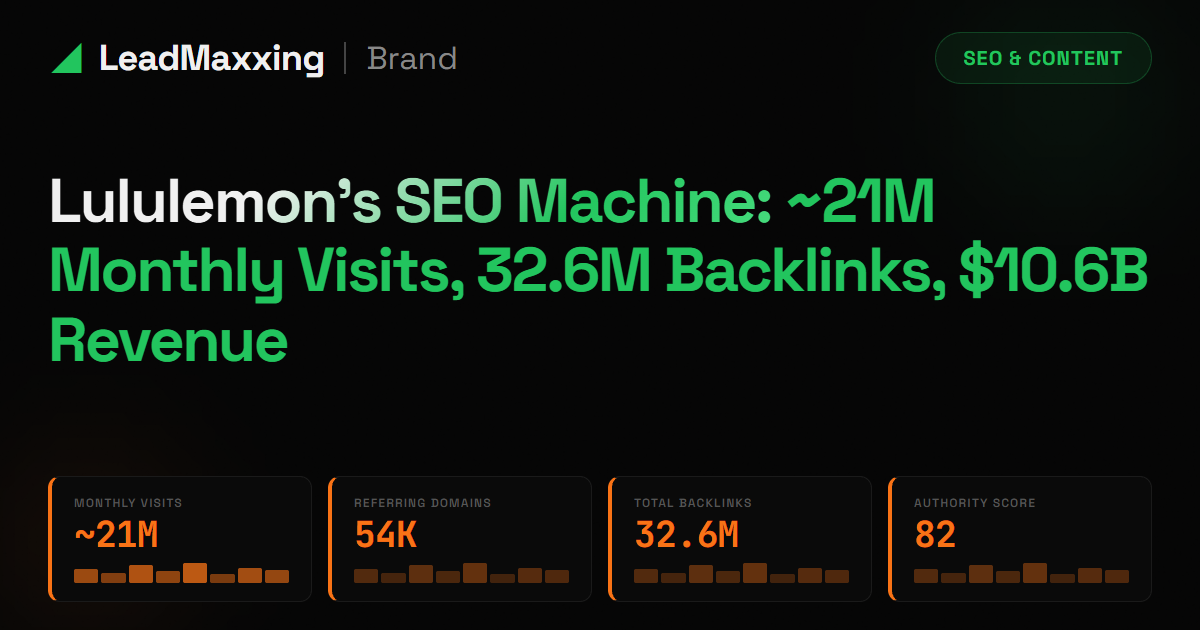
Here's the real story: Lululemon's CSP header is a novel. Their Content-Security-Policy header allows connections to over 50 distinct third-party domains — everything from analytics and advertising to payment processors and AI copywriting tools. That's ~520KB of external JavaScript before a single product image loads. Each one costs real PageSpeed points. (See our full tracking and cookie audit for the complete picture of what runs on every pageview.)
Plus dozens more: TikTok Analytics, Snapchat pixel, Pinterest tag, Meta pixel, Reddit pixel, Spotify pixel, Amazon Ads, The Trade Desk, Bing Ads, Adobe DTM, Medallia, FindMine, Persado, Quiq chat, Awin/CJ affiliate scripts, and more. All confirmed via CSP header analysis on March 20, 2026.
Lululemon could score 90+ on PageSpeed tomorrow by removing Kameleoon, Quantum Metric, Evergage, and their advertising pixels. But then they'd lose their entire experimentation platform, session analytics, real-time personalization, and ad attribution. At $11.1B in annual revenue, a personalized product recommendation or a well-targeted ad retargeting pixel that converts is worth far more than 25 Lighthouse points. If you're under $10M/year, you almost certainly don't need this level of tooling — and your PageSpeed score will thank you for it.
Most of these scripts exist because Lululemon needs dozens of disconnected tools to do what a single platform could handle. LeadMaxxing combines visitor tracking, lead scoring, email automation, and A/B testing in one script — so you don't need to stack tools and tank your PageSpeed.
How Lululemon Serves Images Across a Global CDN
Akamai edge delivery, Contentful image transforms, and Scene7 media streaming
Images are typically 50-70% of total page weight on an ecommerce site. Lululemon uses a multi-CDN approach: Akamai handles global edge delivery, Contentful serves editorial and marketing imagery with on-the-fly transforms, and Adobe Scene7 (confirmed via s7mbrstream.scene7.com in their CSP) handles rich media streaming for product visualization.
lululemon.com.edgekey.net. Sub-second delivery worldwide.cdn.contentful.com and images.ctfassets.net with server-side transforms for responsive delivery.s7mbrstream.scene7.com for zoom, spin, and video.The Simple Stuff You Can Copy Today
- Switch every image to WebP. If you're still serving JPEGs, you're wasting 30% of your bandwidth. Most CDNs and platforms support automatic WebP negotiation now.
- Add
loading="lazy"to every image below the fold. One HTML attribute. Stops the browser from downloading images the user hasn't scrolled to yet. - Set explicit width and height on images. This prevents CLS (layout shift). The browser reserves space before the image loads, so nothing jumps around.
- Use responsive images. A phone doesn't need the 2000px desktop version. Use
srcsetto serve the right size for each device.
Key Findings
- → Lululemon runs 50+ third-party services confirmed via CSP header analysis, adding an estimated ~520KB of external JavaScript to every page load
- → Their infrastructure is Salesforce Commerce Cloud + Akamai CDN + AWS, an enterprise stack handling $11.1B in annual revenue (FY2025, verified via SEC filing) across 811 stores globally
- → 4 high-impact scripts (Kameleoon, Quantum Metric, Evergage, Google Analytics/GTM) account for the majority of main-thread blocking, costing an estimated ~25 PageSpeed points
- → Lululemon uses a multi-CDN image pipeline (Akamai edge + Contentful CDN + Adobe Scene7) for resilient global image delivery across product, editorial, and rich media content
- → Their CSP header confirms Kameleoon for A/B testing, LaunchDarkly for feature flags, and Evergage for real-time personalization — a sophisticated experimentation stack that most DTC brands can't justify at smaller scale
What This Data Means for You
Turning Lululemon's site speed strategy into your competitive advantage
Lululemon's speed story is a masterclass in enterprise tradeoffs. They accept a heavier PageSpeed score because the tools driving that weight — personalization, analytics, experimentation — generate far more revenue than they cost in load time. But you don't need their stack to learn from them. The biggest wins come from basics: CDN caching (even a simple Cloudflare setup), script auditing (count your third-party scripts — you'll be surprised), and image optimization. If you're looking at their advertising strategy or pricing approach, remember that the fastest landing pages convert the best regardless of what tools are behind them. Start with the 20% of effort that gets you 80% of their speed.
LeadMaxxing Automates This Site Speed Playbook
Lululemon spends on 50+ tools for analytics, personalization, and tracking. LeadMaxxing gives you AI-powered visitor identification, lead scoring, and automated email campaigns for $29/month — the same conversion intelligence without the enterprise price tag or the PageSpeed penalty.
See how it works →5 Things You Can Implement Today
Actionable lessons from Lululemon's site speed playbook
You don't need Lululemon's budget. Here's the 20% of effort that gets you 80% of their speed:
Run PageSpeed Insights
Takes 5 minutes. Run your site through PageSpeed Insights. The "Opportunities" section tells you exactly what to fix. Free. This is especially critical for ad landing pages where every fraction of a second impacts your ROAS. LeadMaxxing can automate this for every competitor you track.
Audit Third-Party Scripts
Takes 1 hour. Open Chrome DevTools, Network tab, filter by JS. Count scripts from external domains. Every analytics, chat widget, and popup tool costs speed. LeadMaxxing replaces multiple tools with one lightweight script.
Optimize Images
Takes 1 day. Convert to WebP, add lazy loading, set explicit dimensions. Drops page weight by 40-60%. LeadMaxxing monitors competitor image strategies so you can benchmark against the best.
Monitor Real User Data
Ongoing. Check Search Console Core Web Vitals monthly. Lab scores fluctuate wildly; field data (CrUX) is what Google actually uses. LeadMaxxing tracks visitor experience metrics alongside conversion data.
Supercharge Your Leads with LeadMaxxing
Get a free LeadMaxxing account and start supercharging your leads. Start free →
Get This Analysis For Your Brand FREE
When You Create A Free LeadMaxxing Account
Create a free LeadMaxxing account and we'll generate a full competitive analysis for YOUR brand. The same intelligence you just read — comparison with competitors, actionable strategies, and AI-powered recommendations.
More Lululemon Intelligence
Site Speed Audits for Similar Brands

Frequently Asked Questions
How fast is Lululemon's website?
What technology stack does Lululemon use?
What CDN does Lululemon use?
What third-party scripts slow down Lululemon's website?
Does Lululemon use Shopify?
How does Lululemon's site speed compare to competitors?
What payment methods does Lululemon support online?
Does Lululemon use A/B testing?
Sources & References
aws.amazon.com
pagespeed.web.dev
corporate.lululemon.com
builtwith.com
developer.chrome.com/docs/crux
Methodology: CSP header scan
portent.com