Lululemon’s Pricing Strategy: How an $11B Brand Commands 40–60% Premiums Over Gymshark, Vuori & Nike
We mapped Lululemon’s full product catalog against Gymshark, Alo Yoga, Nike, Vuori, and Fabletics — category breakdowns, discount patterns, and the “We Made Too Much” markdown playbook.
First: Why Should You Care About Pricing Intelligence?
Pricing is the single highest-leverage decision in DTC — and Lululemon wrote the playbook
Because pricing is the most powerful and least understood lever in DTC. A 1% price improvement yields an average 11% profit increase, according to McKinsey. Lululemon is arguably the most disciplined premium pricer in all of athleisure — they built an $11.1 billion business by refusing to compete on price and instead competing on perceived value, proprietary fabrics, and community. Here’s what that discipline looks like in practice:
Lululemon generated $11.1 billion in FY2025 revenue — a 5% year-over-year increase driven by 22% international growth and 44 net new stores, bringing the total to 811 locations worldwide.
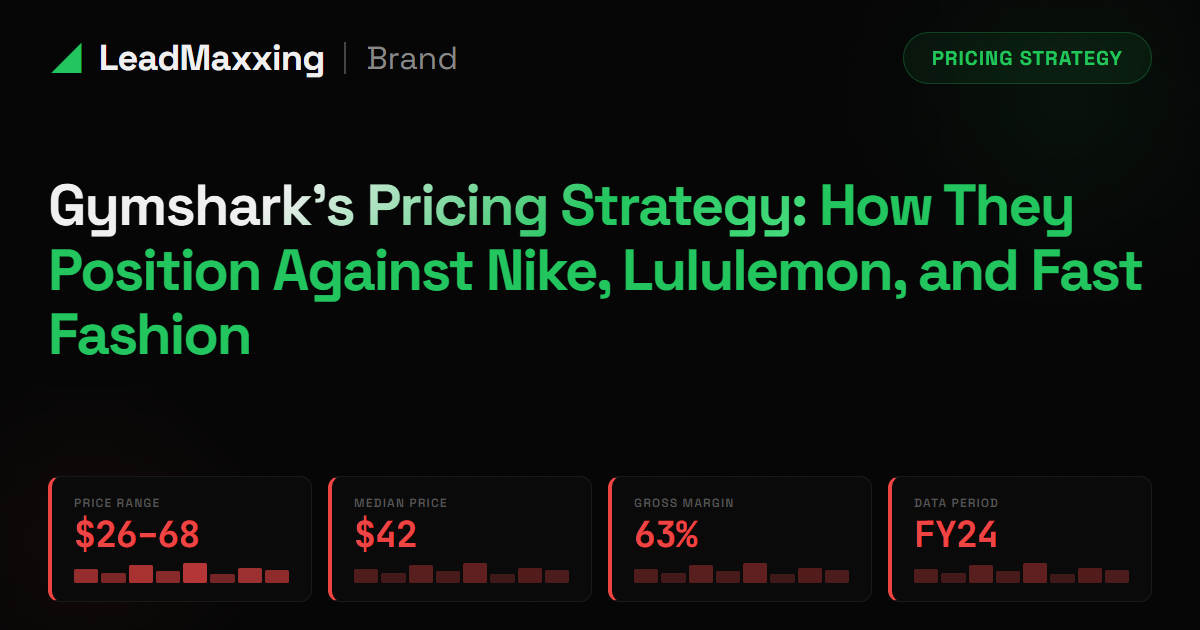
Lululemon maintained a 56.6% gross margin in FY2025 — down 260 basis points year-over-year due to inventory markdowns, but still significantly above the athleisure industry average. By comparison, Gymshark reported 63% gross margins but at a fraction of Lululemon’s scale.
Lululemon charges 40–60% more than Gymshark across every product category. Core leggings at $98–$148 vs $40–$70. Sports bras at $38–$98 vs $26–$44. That premium is the brand — proprietary fabrics, 811 retail stores, and 25+ years of earned perception.
Lululemon
Alo Yoga
Vuori
Gymshark
Price Range Analysis
How Lululemon anchors its catalog between $38 and $198
Lululemon’s core price band runs $98–$148 for flagship products. Entry-level items like bralettes and basic tanks start around $38, while premium outerwear and technical jackets push toward $198. The median product price sits around $98 — roughly double what Gymshark charges for comparable products.
Compare that to Gymshark, where the entire catalog fits between $26–$68. Or Fabletics, where VIP members pay $25–$50 for leggings. Lululemon’s price floor is higher than most competitors’ ceilings — and that’s by design. Their tech stack and infrastructure support a premium experience at every touchpoint.
We estimate based on lululemon.com catalog analysis, March 2026. Percentages represent approximate share of total SKUs in each price band.
The $80–$120 band is Lululemon’s center of gravity. This is where their signature Align, Wunder Train, and Instill leggings live. By clustering their hero products in this range, they anchor the brand perception at “premium but not luxury” — expensive enough to signal quality, affordable enough for repeat purchases.
This is exactly the kind of pricing intelligence LeadMaxxing generates automatically. Our AI scrapes competitor catalogs, maps price bands, and flags when competitors adjust strategy — see how it works →
Category Breakdown
Leggings, sports bras, shorts, tops, and outerwear mapped by price
Leggings are the hero product — and Lululemon’s pricing moat. At $98–$148, they’re the highest-priced core category and the products that built the brand’s reputation. Proprietary fabrics like Nulu (Align), Everlux (Wunder Train), and Luxtreme drive the premium perception.
| Category | Price Range | Core Price | Top Seller Example |
|---|---|---|---|
| Leggings | $98 – $148 | $98–$128 | Align High-Rise Pant 25″ |
| Sports Bras | $38 – $98 | $48–$78 | Energy Bra High Support |
| Shorts | $58 – $98 | $64–$78 | Hotty Hot High-Rise Short 4″ |
| Tops & Tanks | $38 – $108 | $48–$68 | Swiftly Tech Racerback Tank |
| Hoodies & Scuba | $118 – $148 | $128–$138 | Scuba Oversized Full-Zip Hoodie |
| Jackets & Outerwear | $128 – $198 | $148–$168 | Define Jacket Luon |
The Scuba hoodie line is the sleeper hit. At $118–$148, it’s one of the highest-margin categories and consistently sells out in limited colorways. The Scuba franchise demonstrates Lululemon’s ability to charge hoodie prices that exceed most competitors’ outerwear.
Notice how Lululemon’s entry-level sports bras ($38) overlap with Gymshark’s mid-range. Their lowest price point is still a premium product. This protects brand perception — there’s no “cheap Lululemon” product dragging the average down. Their email and CRM flows reinforce full-price selling by promoting new drops rather than discounts.
A full Lululemon outfit (leggings + sports bra + top) costs $184–$324. That’s the price of 2–3 complete Gymshark outfits. Yet Lululemon’s customers don’t flinch — because the brand has earned its premium through fabric innovation, community, and 25+ years of consistent positioning.
Most DTC brands guess at category pricing. LeadMaxxing tracks your competitors’ catalogs daily, flagging new products, price changes, and category shifts before you notice them manually — start free →
Competitor Price Mapping
Lululemon vs Gymshark, Alo Yoga, Nike, Vuori, and Fabletics across every category
Lululemon sits at or near the top of every product category. They’re the price leader in leggings and outerwear, closely matched by Alo Yoga, and significantly above Gymshark and Fabletics. Only Nike’s premium performance lines approach Lululemon’s pricing on select items.
| Category | Lululemon | Alo Yoga | Vuori | Nike | Gymshark |
|---|---|---|---|---|---|
| Leggings | $98–$148 | $98–$128 | $88–$118 | $50–$120 | $40–$70 |
| Sports Bras | $38–$98 | $40–$88 | ~$58 | $30–$55 | $26–$44 |
| Shorts | $58–$98 | $64–$101 | $64–$78 | $35–$65 | $30–$48 |
| Outerwear | $118–$198 | $52–$498 | $70–$188 | $55–$120 | $42–$50 |
| Full Outfit* | $184–$324 | $206–$354 | $150–$260 | $115–$240 | $90–$130 |
*Full outfit = leggings + sports bra + top. Source: Product page scrapes of lululemon.com, aloyoga.com, vuori.com, nike.com, gymshark.com. March 2026.
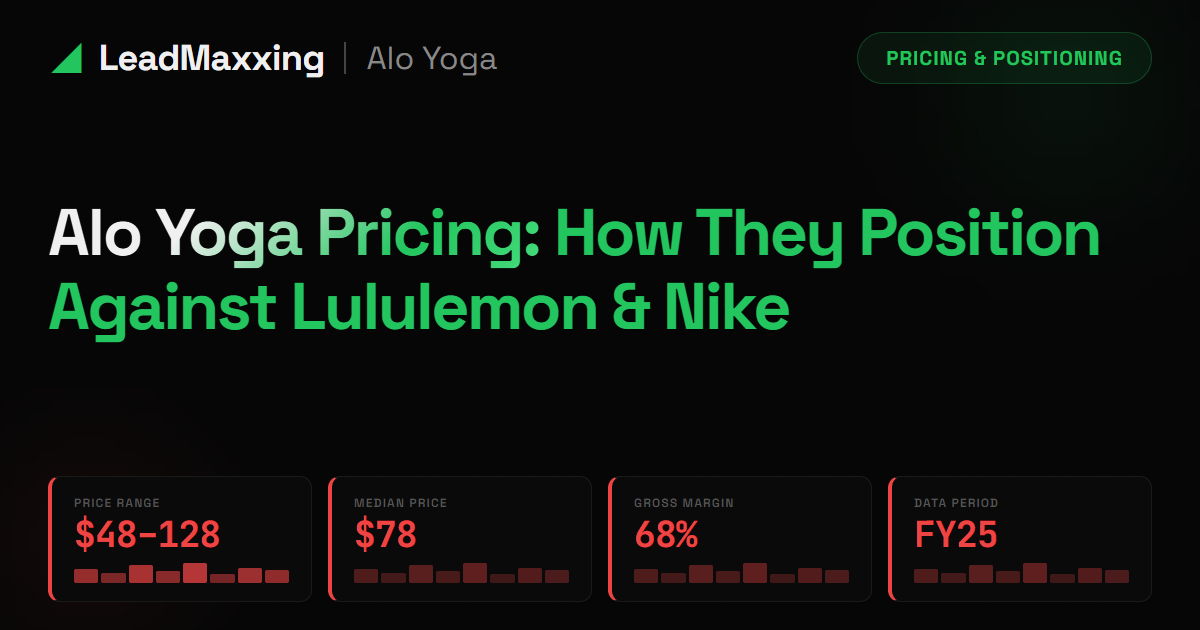
Alo Yoga is the closest pricing peer. Their leggings overlap at $98–$128, and their outerwear actually stretches higher than Lululemon’s (up to $498 for puffer jackets). But Lululemon’s advantage is consistency — their prices are predictable, their quality is proven, and their brand carries 25+ years of earned trust.
The Gymshark gap is enormous. A Gymshark Adapt legging at $60 vs a Lululemon Align at $98 — that’s a 63% premium. Yet Lululemon still outsells Gymshark by a factor of nearly 18x on revenue. The premium positioning works because it’s backed by genuine fabric differentiation and a social media presence that reinforces aspiration over accessibility.
Track Competitor Pricing Automatically
LeadMaxxing monitors competitor product pages, detects price changes, and alerts you when competitors adjust their strategy. The same intelligence shown above — updated daily, for your brand.
Start free →Market Positioning
Where Lululemon sits on the premium-to-value spectrum and why the premium holds
Lululemon owns the “technical premium” tier in athleisure. They don’t compete on price, they don’t compete on trend, and they don’t compete on celebrity endorsement. They compete on fabric technology, community, and the perception that Lululemon is what serious athletes and wellness-focused professionals wear.
Source: Product page scrapes of lululemon.com, aloyoga.com, vuori.com, gymshark.com, fabletics.com. March 2026. Full outfit = leggings + sports bra + top.
The Positioning Playbook
Target Audience
Revenue (FY25)
Store Count
Market Share
Lululemon’s brand positioning rests on four pillars:
- Proprietary Fabrics: Nulu, Luon, Everlux, Luxtreme — patented materials that competitors can’t replicate. The fabric IS the product differentiation.
- Community & Ambassadors: Local ambassador program in every market, free in-store yoga classes, and grassroots events that build tribal loyalty.
- Full-Price Culture: No coupons, no promo codes, no blanket discounts. Overstock goes to WMTM, not a 40%-off sitewide event.
- Omnichannel Experience: 811 stores that function as showrooms + community hubs. Try on in-store, reorder online. Free hemming for members creates switching costs.
Lululemon doesn’t compete on price — they compete on being irreplaceable. Their fabrics can’t be copied. Their community can’t be bought. Their 25-year brand equity can’t be shortcut. The price premium is the output of those moats, not the strategy itself. That’s why competitors like Gymshark and Vuori haven’t closed the gap despite years of trying.
Discount Strategy
The “We Made Too Much” markdown playbook and why Lululemon never runs “sales”
Lululemon doesn’t do traditional sales. No blanket promo codes. No “20% off everything” emails. No rotating coupon codes. Instead, they funnel all markdowns through a single channel: the “We Made Too Much” (WMTM) section. It’s a masterclass in protecting brand equity while still moving overstock.
Black Friday
WMTM (Weekly)
Membership Perks
No Promo Codes
Annual Discount Calendar
Lululemon’s “We Made Too Much” section is discount strategy disguised as inventory management. By framing markdowns as “we overproduced” rather than “we’re having a sale,” they maintain the perception that full-price is the default. New WMTM items drop every Thursday, creating a weekly scarcity event that drives repeat visits. It’s the same urgency as Gymshark’s limited drops, just wrapped in a different narrative. Their paid advertising almost never promotes WMTM — it’s organic traffic only.
Tariff-Driven Price Increases
In early 2026, Lululemon announced modest price increases on select styles. Tariff impacts are expected to cost $320 million in FY2026, with a 220 basis point gross margin hit already absorbed in FY2025. CEO Calvin McDonald signaled “selective” price increases starting in Q2–Q3 FY2026 — the first significant price hikes in several years, reflecting broader supply chain pressures across the athleisure industry.
Key Findings
- → Lululemon generated $11.1 billion in FY2025 revenue with 56.6% gross margins — commanding the highest average price point of any athleisure brand while holding 21.2% US market share (verified fact: Lululemon earnings press release)
- → Lululemon charges 40–60% more than Gymshark across every category: leggings $98–$148 vs $40–$70, sports bras $38–$98 vs $26–$44, outerwear $118–$198 vs $42–$50 (our calculation: product page comparison, March 2026)
- → The “We Made Too Much” markdown section functions as a weekly scarcity event, with new items dropping every Thursday at 5 AM PT and discounts of 20–40% (up to 70% on select items) — no blanket coupon codes ever issued
- → Tariff-driven price increases are coming in Q2–Q3 FY2026, with an expected $320 million impact as Lululemon tries to maintain margins without triggering customer pushback (verified fact: Retail Dive reporting)
- → The tiered Collective loyalty program drives retention with 3 spend-based tiers (free / $500 / $1,000+ annual spend), offering early access, free hemming, and exclusive product drops that increase switching costs
What This Data Means for You
Turning Lululemon’s pricing playbook into your competitive advantage
If you’re a DTC brand, Lululemon’s pricing strategy proves that premium pricing works when it’s backed by genuine differentiation. Their refusal to discount, their proprietary fabric moat, and their community-first approach aren’t just brand marketing — they’re the structural advantages that justify charging 2x what Gymshark does. The data above shows exactly where Lululemon sits relative to competitors across every category. Whether you’re studying their tracking and analytics infrastructure, their SEO strategy, or their site performance, the pattern is the same: invest in quality, protect the premium, and let the margins follow.
LeadMaxxing Automates Competitor Price Monitoring
The pricing intelligence in this report took weeks to compile manually. LeadMaxxing scrapes competitor product pages, maps price bands, flags price changes, and benchmarks your positioning — updated weekly for your brand. Plans start at $29/month.
Try competitor price tracking →5 Things You Can Implement Today
Actionable lessons from Lululemon’s pricing playbook
Build a no-discount culture from day one
Lululemon never issues blanket promo codes. Their markdown strategy (WMTM) is inventory management, not brand erosion. LeadMaxxing tracks competitor discount events so you can time your own markdown windows strategically.
Create fabric or product moats that justify premium
Lululemon’s proprietary Nulu, Everlux, and Luxtreme fabrics are the foundation of their pricing power. If your premium isn’t backed by genuine differentiation, it won’t hold. LeadMaxxing monitors competitor product launches so you can identify gaps to differentiate.
Use tiered loyalty to increase switching costs
Lululemon’s 3-tier Collective program gives members early access, free hemming, and exclusive drops. The higher you spend, the harder it is to leave. LeadMaxxing tracks competitor loyalty programs and membership perks.
Turn markdowns into weekly scarcity events
WMTM drops every Thursday create urgency without devaluing the brand. Instead of permanent clearance, create time-limited markdown windows that train customers to check back regularly. LeadMaxxing alerts you when competitors adjust markdown strategies.
Supercharge Your Leads with LeadMaxxing
Get a free LeadMaxxing account and start supercharging your leads. Start free →
Get This Analysis For Your Brand FREE
When You Create A Free LeadMaxxing Account
Create a free LeadMaxxing account and we'll generate a full competitive analysis for YOUR brand. The same intelligence you just read — comparison with competitors, actionable strategies, and AI-powered recommendations.
More Lululemon Intelligence
Pricing Strategy for Similar Brands
Frequently Asked Questions
How much do Lululemon leggings cost?
Is Lululemon more expensive than Alo Yoga?
Does Lululemon ever have sales?
What is Lululemon’s pricing strategy?
How does Lululemon compare to Vuori on price?
Has Lululemon raised prices recently?
What is Lululemon’s membership program?
Why is Lululemon so expensive compared to Gymshark?
Sources & References
corporate.lululemon.com
retaildive.com
simplycodes.com
thepointsguy.com
shop.lululemon.com
apartstyle.com (brand comparison)
retailtouchpoints.com